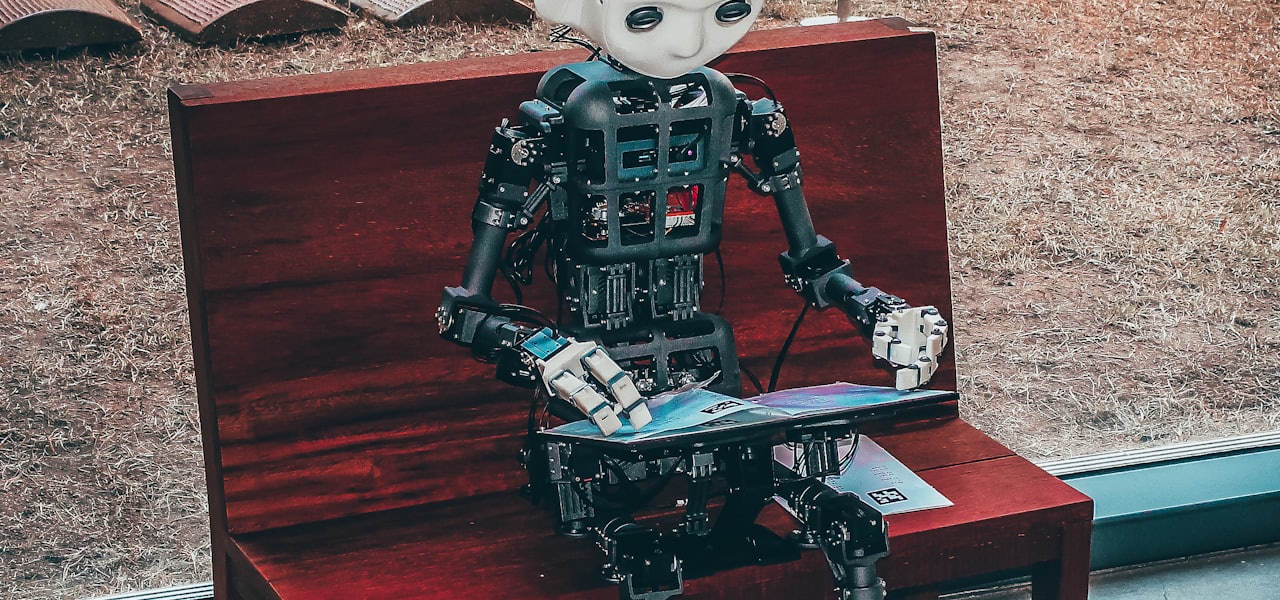
This is a list of notable peer-reviewed academic journals that publish research in the field of artificial intelligence (AI), including areas such as machine learning, computer vision, natural language processing, robotics, and intelligent systems. == General artificial intelligence == Artificial Intelligence (journal) – Elsevier Journal of Artificial Intelligence Research (JAIR) – AI Access Foundation Knowledge-Based Systems – Elsevier == Machine learning == Data Mining and Knowledge Discovery – Springer Machine Learning (journal) – Springer Journal of Machine Learning Research – Microtome Pattern Recognition (journal) – Elsevier Neural Networks (journal) – Elsevier Neural Computation (journal) – MIT Press Neurocomputing (journal) - Elsevier == Deep learning and neural computation == IEEE Transactions on Evolutionary Computation – IEEE IEEE Transactions on Neural Networks and Learning Systems – IEEE Nature Machine Intelligence – Springer Nature == Computer vision == International Journal of Computer Vision – Springer IEEE Transactions on Pattern Analysis and Machine Intelligence – IEEE Machine Vision and Applications – Springer == Natural language processing == Computational Linguistics (journal) – MIT Press Natural Language Processing Transactions of the Association for Computational Linguistics – ACL == Robotics and intelligent systems == IEEE Transactions on Robotics – IEEE Autonomous Robots – Springer Journal of Intelligent & Robotic Systems – Springer == Interdisciplinary and ethics in AI == AI & Society – Springer Artificial Life – MIT Press Philosophy & Technology – Springer Minds and Machines – Springer
Belief–desire–intention model
For popular psychology, the belief–desire–intention (BDI) model of human practical reasoning was developed by Michael Bratman as a way of explaining future-directed intention. BDI is fundamentally reliant on folk psychology (the 'theory theory'), which is the notion that our mental models of the world are theories. It was used as a basis for developing the belief–desire–intention software model. == Applications == BDI was part of the inspiration behind the BDI software architecture, which Bratman was also involved in developing. Here, the notion of intention was seen as a way of limiting time spent on deliberating about what to do, by eliminating choices inconsistent with current intentions. BDI has also aroused some interest in psychology. BDI formed the basis for a computational model of childlike reasoning CRIBB.
Top 10 AI Subtitle Generators Compared (2026)
Curious about the best AI subtitle generator? An AI subtitle generator is software that uses machine learning to help you get more done — it combines speed, accuracy, and an interface that just works. Hands-on testing shows real-world results vary, so a short free trial is the smartest way to decide. Whether you are a beginner or a pro, the right AI subtitle generator slots into your workflow and pays for itself fast. Read on for hands-on impressions, pricing tiers, and the standout features that matter.
How to Choose an AI Video Generator
Looking for the best AI video generator? An AI video generator is software that uses machine learning to help you get more done — it can save you hours every week by automating repetitive work. Most options offer a generous free tier, with paid plans unlocking higher limits, faster processing, and team features. Whether you are a beginner or a pro, the right AI video generator slots into your workflow and pays for itself fast. This guide breaks down the top picks, their pros and cons, and who each one is best for.
Erkki Oja
Erkki Oja (born 22 March 1948) is a Finnish computer scientist and Aalto Distinguished Professor in the Department of Information and Computer Science at Aalto University School of Science. He is recognized for developing Oja's rule, which is a model of how neurons in the brain or in artificial neural networks learn over time. == Early life and education == Oja was born in Helsinki and studied at Helsinki University of Technology, where he received his diploma engineer in 1972, licentiate in technology in 1975 and Doctor of Technology in 1977. == Career == Oja was a research associate at the Center for Cognitive Science at Brown University between 1977 and 1978 and a research fellow at the Academy of Finland from 1976 to 1981. Since 1981, he took up a professorship in applied mathematics at Kuopio University (now University of Eastern Finland). He was a visiting research scholar at Tokyo Institute of Technology from 1983 to 1984. From 1987 to 1993, he was a professor in computer science at the Lappeenranta University of Technology. He moved back to the Helsinki University of Technology (now Aalto University) from 1993 as a professor in computer science. He retired in 2015. == Honors and awards == Oja is a Fellow of the International Association for Pattern Recognition and the IEEE, and a member of the Finnish Academy of Sciences. He served as chairman of the European Neural Network Society between 2000 and 2005, and as the chairman of the Academy of Finland’s Research Council for Natural Sciences and Engineering between 2007 and 2012. He was awarded the Frank Rosenblatt Award for his contributions to artificial intelligence research in 2019. Oja was a member of the Board of Governors for the International Neural Network Society (INNIS) in 2003. He received honorary doctorates from Uppsala University and Lappeenranta University of Technology in 2008.
Rademacher complexity
In computational learning theory (machine learning and theory of computation), Rademacher complexity, named after Hans Rademacher, measures richness of a class of sets with respect to a probability distribution. The concept can also be extended to real valued functions. == Definitions == === Rademacher complexity of a set === Given a set A ⊆ R m {\displaystyle A\subseteq \mathbb {R} ^{m}} , the Rademacher complexity of A is defined as follows: Rad ( A ) := 1 m E σ [ sup a ∈ A ∑ i = 1 m σ i a i ] {\displaystyle \operatorname {Rad} (A):={\frac {1}{m}}\mathbb {E} _{\sigma }\left[\sup _{a\in A}\sum _{i=1}^{m}\sigma _{i}a_{i}\right]} where σ 1 , σ 2 , … , σ m {\displaystyle \sigma _{1},\sigma _{2},\dots ,\sigma _{m}} are independent random variables drawn from the Rademacher distribution i.e. Pr ( σ i = + 1 ) = Pr ( σ i = − 1 ) = 1 / 2 {\displaystyle \Pr(\sigma _{i}=+1)=\Pr(\sigma _{i}=-1)=1/2} for i ∈ { 1 , 2 , … , m } {\displaystyle i\in \{1,2,\dots ,m\}} , and a = ( a 1 , … , a m ) ∈ A {\displaystyle a=(a_{1},\ldots ,a_{m})\in A} . Some authors take the absolute value of the sum before taking the supremum, but if A {\displaystyle A} is symmetric this makes no difference. === Rademacher complexity of a function class === Let S = { z 1 , z 2 , … , z m } ⊆ Z {\displaystyle S=\{z_{1},z_{2},\dots ,z_{m}\}\subseteq Z} be a sample of points and consider a function class F {\displaystyle {\mathcal {F}}} of real-valued functions over Z {\displaystyle Z} . Then, the empirical Rademacher complexity of F {\displaystyle {\mathcal {F}}} given S {\displaystyle S} is defined as: Rad S ( F ) = 1 m E σ [ sup f ∈ F | ∑ i = 1 m σ i f ( z i ) | ] {\displaystyle \operatorname {Rad} _{S}({\mathcal {F}})={\frac {1}{m}}\mathbb {E} _{\sigma }\left[\sup _{f\in {\mathcal {F}}}\left|\sum _{i=1}^{m}\sigma _{i}f(z_{i})\right|\right]} This can also be written using the previous definition: Rad S ( F ) = Rad ( F ∘ S ) {\displaystyle \operatorname {Rad} _{S}({\mathcal {F}})=\operatorname {Rad} ({\mathcal {F}}\circ S)} where F ∘ S {\displaystyle {\mathcal {F}}\circ S} denotes function composition, i.e.: F ∘ S := { ( f ( z 1 ) , … , f ( z m ) ) ∣ f ∈ F } {\displaystyle {\mathcal {F}}\circ S:=\{(f(z_{1}),\ldots ,f(z_{m}))\mid f\in {\mathcal {F}}\}} The worst case empirical Rademacher complexity is Rad ¯ m ( F ) = sup S = { z 1 , … , z m } Rad S ( F ) {\displaystyle {\overline {\operatorname {Rad} }}_{m}({\mathcal {F}})=\sup _{S=\{z_{1},\dots ,z_{m}\}}\operatorname {Rad} _{S}({\mathcal {F}})} Let P {\displaystyle P} be a probability distribution over Z {\displaystyle Z} . The Rademacher complexity of the function class F {\displaystyle {\mathcal {F}}} with respect to P {\displaystyle P} for sample size m {\displaystyle m} is: Rad P , m ( F ) := E S ∼ P m [ Rad S ( F ) ] {\displaystyle \operatorname {Rad} _{P,m}({\mathcal {F}}):=\mathbb {E} _{S\sim P^{m}}\left[\operatorname {Rad} _{S}({\mathcal {F}})\right]} where the above expectation is taken over an identically independently distributed (i.i.d.) sample S = ( z 1 , z 2 , … , z m ) {\displaystyle S=(z_{1},z_{2},\dots ,z_{m})} generated according to P {\displaystyle P} . == Intuition == The Rademacher complexity is typically applied on a function class of models that are used for classification, with the goal of measuring their ability to classify points drawn from a probability space under arbitrary labellings. When the function class is rich enough, it contains functions that can appropriately adapt for each arrangement of labels, simulated by the random draw of σ i {\displaystyle \sigma _{i}} under the expectation, so that this quantity in the sum is maximized. The Rademacher complexity of a set A {\displaystyle A} can be rewritten as Rad ( A ) := 1 m E σ [ sup a ∈ A ∑ i = 1 m σ i a i ] = 1 m 2 m ∑ σ ∈ { − 1 / m , + 1 / m } m [ sup a ∈ A ⟨ σ , a ⟩ ] . {\displaystyle \operatorname {Rad} (A):={\frac {1}{m}}\mathbb {E} _{\sigma }\left[\sup _{a\in A}\sum _{i=1}^{m}\sigma _{i}a_{i}\right]={\frac {1}{{\sqrt {m}}2^{m}}}\sum _{\sigma \in \{-1/{\sqrt {m}},+1/{\sqrt {m}}\}^{m}}\left[\sup _{a\in A}\langle \sigma ,a\rangle \right].} Each term in the summation is the farthest distance of the set A {\displaystyle A} from the origin, along a unit-length direction σ {\displaystyle \sigma } . The directions are along the vertices of a hypercube. Thus, we can also write it as Rad ( A ) = 1 2 m 1 2 m − 1 ∑ σ ∈ { − 1 / m , + 1 / m } m / { − 1 , + 1 } [ sup a ∈ A ⟨ σ , a ⟩ − inf a ∈ A ⟨ σ , a ⟩ ] {\displaystyle \operatorname {Rad} (A)={\frac {1}{2{\sqrt {m}}}}{\frac {1}{2^{m-1}}}\sum _{\sigma \in \{-1/{\sqrt {m}},+1/{\sqrt {m}}\}^{m}/\{-1,+1\}}\left[\sup _{a\in A}\langle \sigma ,a\rangle -\inf _{a\in A}\langle \sigma ,a\rangle \right]} Here, the set { − 1 / m , + 1 / m } m / { − 1 , + 1 } {\displaystyle \{-1/{\sqrt {m}},+1/{\sqrt {m}}\}^{m}/\{-1,+1\}} denotes half of the vertices of a hypercube, selected so that each diagonal has exactly one vertex selected. In words, this states that 2 m Rad ( A ) {\displaystyle 2{\sqrt {m}}\operatorname {Rad} (A)} is precisely the average width of the set A {\displaystyle A} along all diagonal directions of a hypercube. == Examples == A singleton set has 0 width in any direction, so it has Rademacher complexity 0. The set A = { ( 1 , 1 ) , ( 1 , 2 ) } ⊆ R 2 {\displaystyle A=\{(1,1),(1,2)\}\subseteq \mathbb {R} ^{2}} has average width 1 / 2 {\displaystyle 1/{\sqrt {2}}} along the two diagonal directions of the square, so it has Rademacher complexity 1 / 4 {\displaystyle 1/4} . The unit cube [ 0 , 1 ] m {\displaystyle [0,1]^{m}} has constant width m {\displaystyle {\sqrt {m}}} along the diagonal directions, so it has Rademacher complexity 1 / 2 {\displaystyle 1/2} . Similarly, the unit cross-polytope { x ∈ R m : ‖ x ‖ 1 ≤ 1 } {\displaystyle \{x\in \mathbb {R} ^{m}:\|x\|_{1}\leq 1\}} has constant width 2 / m {\displaystyle 2/{\sqrt {m}}} along the diagonal directions, so it has Rademacher complexity 1 / m {\displaystyle 1/m} . == Using the Rademacher complexity == The Rademacher complexity can be used to derive data-dependent upper-bounds on the learnability of function classes. Intuitively, a function-class with smaller Rademacher complexity is easier to learn. === Bounding the representativeness === In machine learning, it is desired to have a training set that represents the true distribution of some sample data S {\displaystyle S} . This can be quantified using the notion of representativeness. Denote by P {\displaystyle P} the probability distribution from which the samples are drawn. Denote by H {\displaystyle H} the set of hypotheses (potential classifiers) and denote by F {\displaystyle {\mathcal {F}}} the corresponding set of error functions, i.e., for every hypothesis h ∈ H {\displaystyle h\in H} , there is a function f h ∈ F {\displaystyle f_{h}\in F} , that maps each training sample (features,label) to the error of the classifier h {\displaystyle h} (note in this case hypothesis and classifier are used interchangeably). For example, in the case that h {\displaystyle h} represents a binary classifier, the error function is a 0–1 loss function, i.e. the error function f h {\displaystyle f_{h}} returns 0 if h {\displaystyle h} correctly classifies a sample and 1 else. We omit the index and write f {\displaystyle f} instead of f h {\displaystyle f_{h}} when the underlying hypothesis is irrelevant. Define: L P ( f ) := E z ∼ P [ f ( z ) ] {\displaystyle L_{P}(f):=\mathbb {E} _{z\sim P}[f(z)]} – the expected error of some error function f ∈ F {\displaystyle f\in {\mathcal {F}}} on the real distribution P {\displaystyle P} ; L S ( f ) := 1 m ∑ i = 1 m f ( z i ) {\displaystyle L_{S}(f):={1 \over m}\sum _{i=1}^{m}f(z_{i})} – the estimated error of some error function f ∈ F {\displaystyle f\in {\mathcal {F}}} on the sample S {\displaystyle S} . The representativeness of the sample S {\displaystyle S} , with respect to P {\displaystyle P} and F {\displaystyle {\mathcal {F}}} , is defined as: Rep P ( F , S ) := sup f ∈ F ( L P ( f ) − L S ( f ) ) {\displaystyle \operatorname {Rep} _{P}({\mathcal {F}},S):=\sup _{f\in F}(L_{P}(f)-L_{S}(f))} Smaller representativeness is better, since it provides a way to avoid overfitting: it means that the true error of a classifier is not much higher than its estimated error, and so selecting a classifier that has low estimated error will ensure that the true error is also low. Note however that the concept of representativeness is relative and hence can not be compared across distinct samples. The expected representativeness of a sample can be bounded above by the Rademacher complexity of the function class: If F {\displaystyle {\mathcal {F}}} is a set of functions with range within [ 0 , 1 ] {\displaystyle [0,1]} , then Rad P , m ( F ) − ln 2 2 m ≤ E S ∼ P m [ Rep P ( F , S ) ] ≤ 2 Rad P , m ( F ) {\displaystyle \operatorname {Rad} _{P,m}({\mathcal {F}})-{\sqrt {\frac {\ln 2}{2m}}}\leq \mathbb {E} _{S\sim P^{m}}[\operatorname {Rep} _{P}({\
Timnit Gebru
Timnit W. Gebru (Amharic and Tigrinya: ትምኒት ገብሩ; 1982/1983) is an Eritrean Ethiopian-born computer scientist who works in the fields of artificial intelligence (AI), algorithmic bias and data mining. She is a co-founder of Black in AI, an advocacy group that has pushed for more Black roles in AI development and research. She is the founder of the Distributed Artificial Intelligence Research Institute (DAIR). In December 2020, public controversy erupted over the circumstances surrounding Gebru's departure from Google, where she was technical co-lead of the Ethical Artificial Intelligence Team. Gebru had coauthored a paper on the risks of large language models (LLMs) acting as stochastic parrots, and submitted it for publication. According to Jeff Dean, head of Google AI, the paper was submitted without waiting for Google's internal review, which then asserted that it ignored too much relevant research. Google management requested that Gebru either withdraw the paper or remove the names of all the authors employed by Google. Gebru requested the identity and feedback of every reviewer, and stated that if Google refused, she would talk to her manager about "a last date". Google terminated her employment immediately, stating that they were accepting her resignation. Gebru maintained that she had not formally offered to resign, and only threatened to. Gebru has been widely recognized for her expertise in the ethics of artificial intelligence. She was named one of the World's 50 Greatest Leaders by Fortune and one of Nature's ten people who shaped science in 2021, and in 2022, one of Time's most influential people. == Early life and education == Gebru was raised in Addis Ababa, Ethiopia. Her father, an electrical engineer with a Doctor of Philosophy (PhD), died when she was five years old, and she was raised by her mother, an economist. Both her parents are from Eritrea. When Gebru was 15, during the Eritrean–Ethiopian War, she fled Ethiopia after some of her family were deported to Eritrea and compelled to fight in the war. She was initially denied a U.S. visa and briefly lived in Ireland, but she eventually received political asylum in the U.S., an experience she said was "miserable". Gebru settled in Somerville, Massachusetts to attend high school, where she says she immediately started to experience racial discrimination, with some teachers refusing to allow her to take certain Advanced Placement courses, despite being a high-achiever. After she completed high school, an encounter with the police set Gebru on a course toward a focus on ethics in technology. A friend of hers, a Black woman, was assaulted in a bar, and Gebru called the police to report it. She says that instead of filing the assault report, her friend was arrested and remanded to a cell. Gebru called it a pivotal moment and a "blatant example of systemic racism." In 2001, Gebru was accepted at Stanford University. There, she earned her Bachelor of Science and Master of Science degrees in electrical engineering and her PhD in computer vision in 2017. Gebru was advised during her PhD program by Fei-Fei Li. During the 2008 United States presidential election, Gebru canvassed in support of Barack Obama. Gebru presented her doctoral research at the 2017 LDV Capital Vision Summit competition, where computer vision scientists present their work to members of industry and venture capitalists. Gebru won the competition, starting a series of collaborations with other entrepreneurs and investors. Both during her PhD program in 2016 and in 2018, Gebru returned to Ethiopia with Jelani Nelson's programming campaign, AddisCoder. While working on her PhD, Gebru authored a paper that was never published about her concern over the future of AI. She wrote of the dangers of the lack of diversity in the field, centered on her experiences with the police and on a ProPublica investigation into predictive policing, which revealed a projection of human biases in machine learning. In the paper, she scathed the "boy's club culture", reflecting on her experiences at conference gatherings of drunken male attendees sexually harassing her, and criticized the hero worship of the field's celebrities. == Career == === 2004–2013: Software development at Apple === Gebru joined Apple as an intern while at Stanford, working in their hardware division making circuitry for audio components, and was offered a full-time position the following year. Of her work as an audio engineer, her manager told Wired she was "fearless", and well-liked by her colleagues. During her tenure at Apple, Gebru became more interested in building software, namely computer vision that could detect human figures. She went on to develop signal processing algorithms for the first iPad. At the time, she said she did not consider the potential use for surveillance, saying "I just found it technically interesting." Long after leaving the company, during the #AppleToo movement in the summer of 2021, which was led by Apple engineer Cher Scarlett, who consulted with Gebru, Gebru revealed she experienced "so many egregious things" and "always wondered how they manage[d] to get out of the spotlight." She said that accountability at Apple was long overdue, and warned they could not continue to fly under the radar for much longer. Gebru also criticized the way the media covers Apple and other tech giants, saying that the press helps shield such companies from public scrutiny. === 2013–2017: Research at Stanford and Microsoft === In 2013, Gebru joined Fei-Fei Li's lab at Stanford, where she combined deep learning with Google Street View to estimate the demographics of United States neighbourhoods, showing that socioeconomic attributes such as voting patterns, income, race, and education can be inferred from observations of cars. In 2015, Gebru attended the field's top conference, Neural Information Processing Systems (NIPS), in Montreal, Canada. Out of 3,700 attendees, she noted she was one of only a few Black researchers. When she attended again the following year, she kept a tally and noted that there were only five Black men and that she was the only Black woman out of 8,500 delegates. Together with her colleague Rediet Abebe, Gebru founded Black in AI, a community of Black researchers working in artificial intelligence that aims to increase the presence, visibility, and well-being of Black professionals and leaders within the field. In the summer of 2017, Gebru joined Microsoft as a postdoctoral researcher in the Fairness, Accountability, Transparency, and Ethics in AI (FATE) lab. In 2017, Gebru spoke at the Fairness and Transparency conference, where MIT Technology Review interviewed her about biases that exist in AI systems and how adding diversity in AI teams can fix that issue. In her interview with Jackie Snow, Snow asked Gebru, "How does the lack of diversity distort artificial intelligence and specifically computer vision?" and Gebru pointed out that there are biases that exist in the software developers. While at Microsoft, Gebru co-authored a research paper called Gender Shades, which became the namesake of a project of a broader Massachusetts Institute of Technology project led by co-author Joy Buolamwini. The pair investigated facial recognition software, finding that in one particular implementation Black women were 35% less likely to be recognized than White men. === 2018–2020: Artificial intelligence ethics at Google === Gebru joined Google in 2018, where she co-led a team on the ethics of artificial intelligence with Margaret Mitchell. She studied the implications of artificial intelligence, looking to improve the ability of technology to do social good. In 2019, Gebru and other artificial intelligence researchers "signed a letter calling on Amazon to stop selling its facial-recognition technology to law enforcement agencies because it is biased against women and people of color", citing a study that was conducted by MIT researchers showing that Amazon's facial recognition system had more trouble identifying darker-skinned females than any other technology company's facial recognition software. In a New York Times interview, Gebru has further expressed that she believes facial recognition is too dangerous to be used for law enforcement and security purposes at present. === Exit from Google === In 2020 Gebru and five co-authors wrote a paper titled "On the Dangers of Stochastic Parrots: Can Language Models Be Too Big? 🦜". The paper examined risks of very large language models, including their environmental footprint, financial costs, the inscrutability of large models, the potential for LLMs to display prejudice against certain groups, the inability of LLMs to understand the language they process, and the use of LLMs to spread disinformation. In December 2020, her employment with Google ended after Google management asked her to either withdraw the paper before publication, or remove the names of all the Google employees from